"I'm absolutely thrilled with Ms. Glena, my account manager. She consistently responds in a professional and appropriate manner. We've expanded our team to meet my company's needs, and in the process, we've all become great friends. I highly recommend Remote CoWorker!"
Hearn Marketing
Marketing Coordinator

4.9 (454 reviews)
Reviewed On


"It has been an incredible experience with Remote Coworker! Their management is very communicative and always on top of their game. Highly recommend them to anyone who is looking for these services!"
Couch and Coe
Marketing Coordinator
4.9 (454 reviews)
Reviewed On
"We have had a great experience with our Remote Coworker VA's we started with one and have gone to five. They have been a great help to make us more efficient in our day-to-day operations.
Matthew Brian Thompson
Marketing Coordinator
4.9 (454 reviews)
Reviewed On
"They were efficient, made the process easy and I would highly recommend them. My assistant is great! Fast learner and is always staying busy!"
Megan Dinh
Marketing Coordinator
4.9 (454 reviews)
Reviewed On


Our clients saved more than $100M in payroll expenses last year.
Certified By

ISO 27001 Certified

ISO 27001 Certified

ISO 27001 Certified


Are you looking for a job or to hire a Virtual Assistant?
Get started absolutely free.
With us, you save time and get access to top-tier professionals trusted by businesses worldwide.
10 min read




Business process outsourcing (BPO) has shifted from a back-office cost tactic to a core driver of global business strategy. Today, the BPO industry supports everything from customer experience and finance operations to AI-powered automation, cloud computing environments, and data analytics initiatives.
As companies work to streamline operations, protect data security, and stay competitive in a rapidly evolving global market, outsourcing has become embedded in long-term operating models rather than short-term experiments.
To provide a clear view of where the industry stands, Remote CoWorker compiled 35 essential BPO statistics shaping market size, growth, and transformation in 2026.

The global business process outsourcing market is valued at USD 358.58 billion in 2026, up from $328.4 billion in 2025. That marks more than a doubling in size over the past decade, compared to approximately $150 billion in 2015.
Market trends indicate another $337.19 billion increase to reach $695.77 billion by 2033 at a 9.9% CAGR (compound annual growth rate).
The explosive market growth is fueled by expansion in contracted business functions such as customer support, finance and accounting, HR administration, and back-office processing. This signals that enterprises are increasing the scope and duration of BPO engagements, not simply renewing short-term cost-saving contracts.
Source: Grand View Research, Evolve Capital Partners.

The global outsourcing services market was valued at $3.8 trillion in 2024 and is expanding at an 11.3% CAGR, providing the economic backdrop for BPO expansion.
While the total includes IT and engineering services, its scale signals sustained corporate reliance on externally delivered operations, including finance, customer support, and data processing functions that define the BPO segment.
Source: Grand View Research.
North America is the largest regional market for business process outsourcing. Strong demand across banking, financial services, and insurance (BFSI), healthcare administration, insurance processing, and IT support continues to anchor the region’s BPO spending.
While outsourcing statistics reveal Asia Pacific represents the largest outsourcing market share overall at roughly 39%, with countries like Australia, Japan, Philippines, and Malaysia as a dominant global delivery hub, North America generates the highest revenue concentration within the BPO segment, particularly in high-value, compliance-intensive service lines.
Source: Grand View Research.
In 2025, the U.S. BPO market reached $93.39 billion, making it the largest national market worldwide. The next closest countries are China with $34.04 billion and Germany with $21.44 billion.
The 10 largest country markets are:
The distribution highlights the concentration of BPO spending in advanced economies, even as global delivery hubs remain geographically diversified.
Source: Cognitive Market Research.
The U.S. remains the largest single national market for business process outsourcing, and sustained expansion is expected at a 9.7% CAGR through 2033.
Sources: Statista, Grand View Research.
Finance and accounting remained the largest service segment in the BPO market in 2025, and the segment is projected to surpass $150 billion in annual revenue by 2033, reinforcing its dominant position within BPO.
Demand continues to center on accounts payable and receivable, payroll processing, tax administration, and financial reporting, but delivery models are evolving. The segment’s scale reflects not just cost efficiency priorities, but growing reliance on technology-enabled finance operations.
Source: Grand View Research.
Beyond its above-average growth rate, customer service outsourcing is projected to scale into the $115 to 120 billion range by 2033, at a CAGR of 11.2%.
As omnichannel engagement becomes standard, enterprises are externalizing voice, chat, and digital support operations to providers with global delivery capacity and analytics-driven quality management.
Source: Grand View Research.
Human resource BPO is forecast to grow steadily across the decade, expanding from roughly $60 to 70 billion in the early 2020s to more than $140 billion by 2033.
The growth reflects enterprise reliance on outsourced payroll administration, benefits management, compliance support, and workforce analytics.
Source: Grand View Research.
India remains the dominant offshore outsourcing hub, accounting for nearly half of global offshore BPO market share. Its leadership reflects a combination of large English-speaking talent pools, mature vendor ecosystems, and strong enterprise demand for scalable service delivery.
Source: WifiTalents.
The Philippines is one of the world’s largest outsourcing hubs, with more than 1.3 million people working across customer service, finance and accounting, technical support, and back-office process management roles.
The scale of the Philippine workforce underscores the country’s position as a primary global delivery center for English-language BPO and related services.
Source: WifiTalents.
Two-thirds of U.S. companies report externalizing at least one business function. Adoption varies significantly by organizational scale:
The gap highlights how operational complexity, compliance requirements, and process volume tend to increase reliance on structured third-party service delivery as companies grow.
Sources: DemandSage, Marketbiz.
This is based on projected revenue of $434.99 billion in 2026, rising at a modest 3.08% CAGR through 2030.
By the same metrics, in 2019 the global BPO market had a $26 billion share of the $92.5 billion total outsourcing services market.
This near-term outlook reflects current global spending on outsourced business process services and uses a conservative revenue model focused on direct provider earnings, which explains why its growth pace is far lower than the longer-range projection from Grand View Research.
Source: Statista.
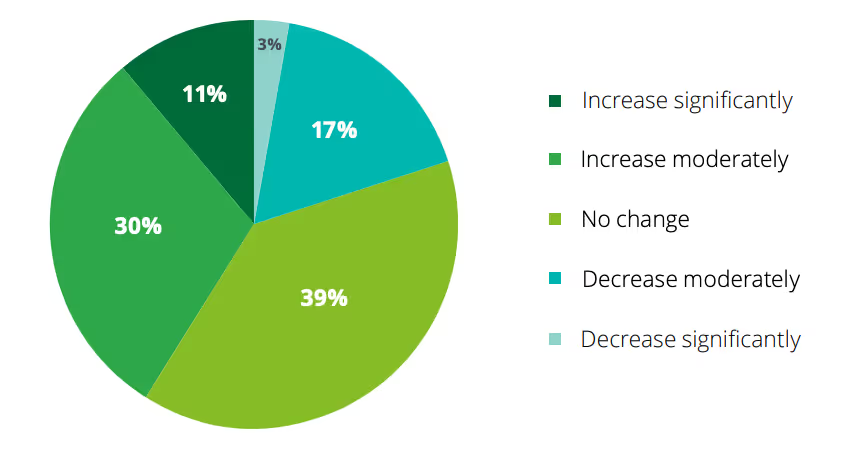
Survey data shows 11% expect significant budget expansion and 30% project moderate growth.
Although some firms foresee flat or declining investment, forward-looking sentiment remains net positive, indicating that external service models, including BPO, continue to factor into medium-term planning cycles.
Source: Deloitte.

Virtual assistant statistics reveal the market value of the VA segment is projected to expand from $8.7 billion in 2023 to more than $29 billion by 2031, growing at a 28.4% CAGR over the forecast period. Few service lines within BPO are scaling at this pace.
Source: Verified Market Research.
Procurement and supply chain outsourcing is expected to nearly double in size compared to early-decade levels. Increased complexity in vendor management, logistics coordination, and global sourcing strategies is driving adoption of specialized third-party process management.
Source: Grand View Research.
Workforce constraints now rank ahead of pure cost reduction as the leading driver of BPO adoption. Other top motivators include:
Source: Deloitte.
Over half of business leaders who responded to the latest Deloitte Global Outsourcing Survey said they rely on BPO providers to manage structured, customer-facing processes. These may include sales operations, marketing execution, customer service delivery, and order management.
The roughly 10-point increase between 2022 and 2024 indicates accelerating comfort with embedding third-party teams directly into revenue and customer experience workflows rather than limiting outsourcing to back-office support.
Source: Deloitte.
Outsourcing is moving beyond transactional support into knowledge-intensive processes, where third-party providers are now trusted with capabilities once kept strictly in-house.
Source: Deloitte.
A 2021 survey found that 87% of organizations classify outsourced and third-party professionals as part of their workforce rather than as peripheral vendors. The finding marked a post-pandemic inflection point, when distributed operating models accelerated integration between internal employees and externally delivered teams.
For BPO specifically, the data signals that external service providers are often embedded directly into day-to-day operations.
Source: The Wall Street Journal.
The data indicates that externally delivered administrative support is not confined to startups or microbusinesses.
Source: ai2people.
Rather than signaling scale advantages, the data points to strategic necessity: in fields populated with larger organizations, smaller firms often turn to outside partners to maintain service levels or process capacity without expanding fixed headcount.
Source: DemandSage.
While Deloitte’s 2020 survey showed organizations generally viewed cloud as a primary outsourcing enabler, by 2025 more than half of BPO revenue was delivered through cloud-based deployment models.
Providers increasingly integrate artificial intelligence (AI), robotic process automation (RPA), and advanced analytics into cloud-native environments, enabling real-time insights, automated workflows, and scalable service delivery models.
Source: Grand View Research, Deloitte.
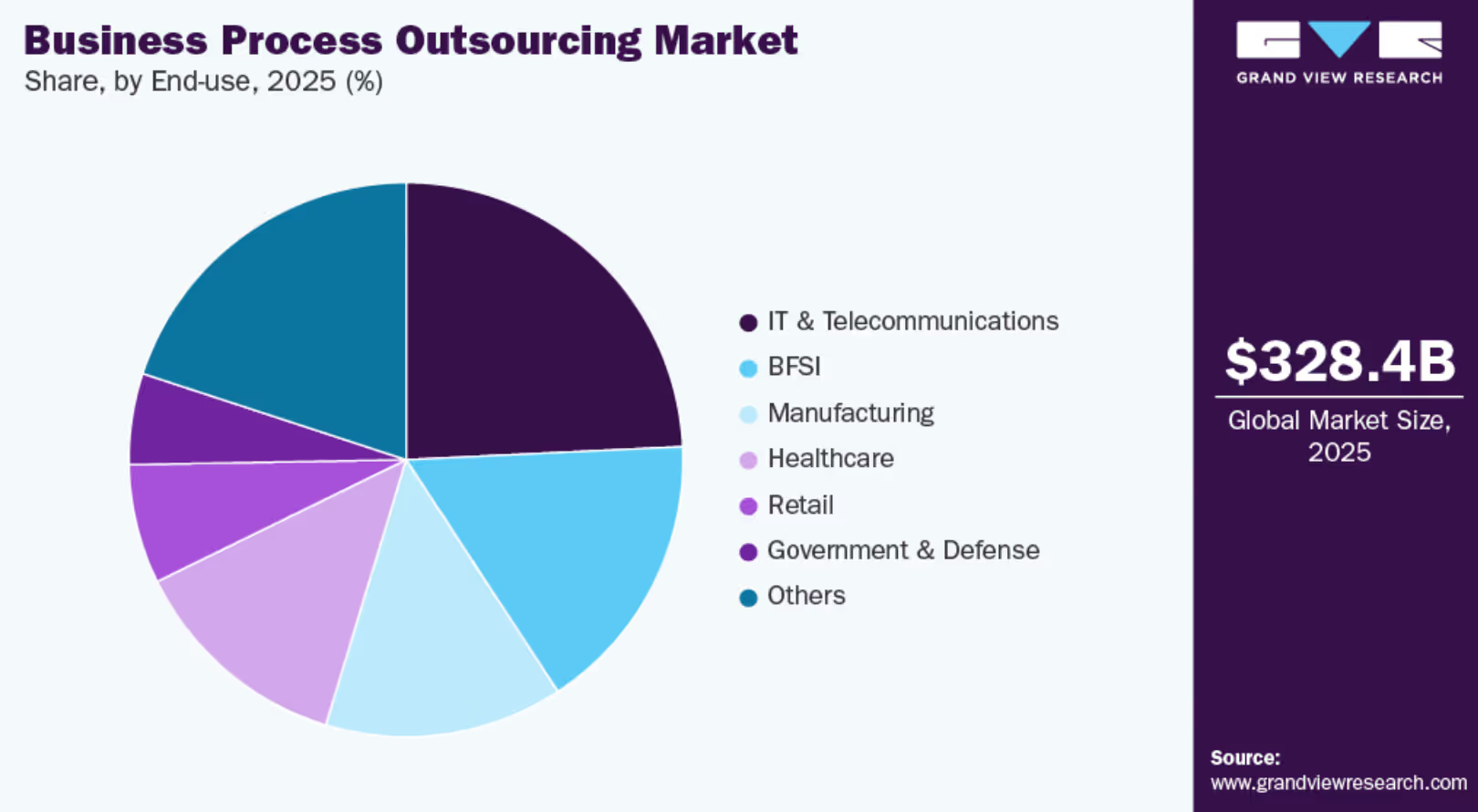
The IT & telecom industry accounted for the largest share of BPO end-use revenue. Demand for the segment represents well over $150 billion in projected annual BPO spending by the early 2030s.
BFSI followed at roughly 17%, with manufacturing (~15%) and healthcare (~14%) also comprising substantial portions of the market. Retail (~7%) and government and defense (~6%) represented smaller but meaningful shares, while other industries collectively accounted for approximately 17%.
Source: Grand View Research.
Information technology outsourcing (ITO) accounts for the majority of global outsourcing deal value, underscoring how technology infrastructure, software services, and digital operations remain the core drivers of outsourcing demand.
Source: WifiTalents.
Rather than maintaining analytics entirely in-house, organizations are increasingly sourcing specialized expertise to support data engineering, reporting infrastructure, advanced modeling, and insight generation.
Source: Deloitte.
Cybersecurity ranks as the leading external challenge facing enterprise leaders, and a large majority report relying on third-party vendors to provide security operations, threat monitoring, and risk management support, either partially or in full.
Source: Deloitte.
Nearly three-quarters of large organizations rely on multiple outsourcing vendors simultaneously, reflecting a risk-diversification strategy and a shift away from single-provider dependency.
Source: WifiTalents.
While innovation and service quality are often discussed as outsourcing benefits, the data shows BPO continues to be primarily a cost-optimization strategy at the enterprise level.
On average, respondents also reported an 11% improvement in quality performance after outsourcing.
Source: ISG.
Savings at this level are typically achieved through wage differentials, lower infrastructure expenses, and reduced benefit obligations compared with in-house staffing models.
Source: WifiTalents.
Five years ago, most organizations were still evaluating RPA adoption in outsourcing. Today, automation is no longer experimental.
RPA technology significantly lowers execution costs by replacing manual workflows with software bots, allowing providers to scale delivery while maintaining margins.
Source: WifiTalents, Deloitte.
Per-employee spending metrics highlight how outsourcing is becoming embedded into standard operating cost structures rather than treated as occasional external support.
Source: Statista.
Typical outsourcing agreements run multiple years rather than short project cycles, indicating that most enterprises treat external providers as long-term operational partners rather than temporary vendors.
Source: WifiTalents.
Between 20% and 25% of engagements, including in the BPO segment, reportedly end in the first 24 months. Early-stage attrition often coincides with governance misalignment or shifting business priorities.
Source: DemandSage.
Most companies characterize their outsourcing experiences positively. Structured oversight and clear performance expectations may differentiate durable BPO partnerships from short-lived arrangements.
Source: Entrepreneur.
While this represents a small fraction of the total U.S. workforce of 171.9 million people in 2026, the impact tends to concentrate in IT services, manufacturing support, back-office operations, and customer service functions.
Source: Zippia, Federal Reserve Bank of St. Louis.
As the BPO industry continues to scale globally, companies need reliable operational partners, not just additional headcount.
Remote CoWorker helps businesses implement flexible BPO services that reduce overhead, improve efficiency, and support sustainable growth. From customer support and call centers to back office administration and sales operations, we provide structured outsourcing solutions designed to integrate seamlessly into your existing workflows.
Whether you're optimizing costs, increasing capacity, or refining process execution, our team supports your long-term operational strategy.
Ready to find remote talent and strengthen your BPO services strategy? Schedule a free strategy call today.
We believe happy teams build great companies. That’s why we ensure the virtual assistants we provide are supported, skilled, and ready to help your business succeed.


Copyright © 2026 RemoteCoWorker | All Rights Reserved.