"I'm absolutely thrilled with Ms. Glena, my account manager. She consistently responds in a professional and appropriate manner. We've expanded our team to meet my company's needs, and in the process, we've all become great friends. I highly recommend Remote CoWorker!"
Hearn Marketing
Marketing Coordinator

4.9 (454 reviews)
Reviewed On


"It has been an incredible experience with Remote Coworker! Their management is very communicative and always on top of their game. Highly recommend them to anyone who is looking for these services!"
Couch and Coe
Marketing Coordinator
4.9 (454 reviews)
Reviewed On
"We have had a great experience with our Remote Coworker VA's we started with one and have gone to five. They have been a great help to make us more efficient in our day-to-day operations.
Matthew Brian Thompson
Marketing Coordinator
4.9 (454 reviews)
Reviewed On
"They were efficient, made the process easy and I would highly recommend them. My assistant is great! Fast learner and is always staying busy!"
Megan Dinh
Marketing Coordinator
4.9 (454 reviews)
Reviewed On


Our clients saved more than $100M in payroll expenses last year.
Certified By

ISO 27001 Certified

ISO 27001 Certified

ISO 27001 Certified


Are you looking for a job or to hire a Virtual Assistant?
Get started absolutely free.
With us, you save time and get access to top-tier professionals trusted by businesses worldwide.
12 min read




Outsourcing continues to evolve from a cost-cutting tactic into a strategic lever for growth, innovation, and access to global talent. Organizations are no longer viewing outsourcing as limited to back-office efficiency; they’re integrating AI, rebalancing sourcing models, and outsourcing core business capabilities to stay competitive.
At Remote CoWorker, we’ve gathered 35 essential outsourcing statistics that highlight how companies are reshaping their workforce strategies, where investment is growing, and what’s driving outsourcing decisions in 2026 and beyond.

Valued at USD 3.8 trillion in 2024, experts predict the market will grow at an 11.3% CAGR (compound annual growth rate) during the forecast period.
The scale and projected expansion of the outsourcing economy reflect sustained enterprise demand for cost efficiency, digital transformation, and specialized capabilities across IT, finance, engineering, and customer operations.
Continued double-digit growth suggests outsourcing is embedded in long-term operating models rather than used solely as a short-term cost-reduction tactic.
Source: Grand View Research.

Artificial intelligence is now embedded in most outsourcing relationships. The Deloitte survey revealed 83% of executives say they are incorporating AI into outsourced services.
However, results lag adoption. Just 25% report reductions in vendor service costs or improvements in service quality. At the same time, 20% of organizations are building formal digital workforce strategies to manage AI tools and automation bots.
The findings indicate that while AI-powered outsourcing is widespread, structured oversight and measurable ROI are still developing.
Source: Deloitte.
Unlike functions primarily outsourced to cut costs or improve efficiency, cybersecurity outsourcing is largely a risk mitigation and resilience strategy. More than four-fifths depend on external vendors for core security operations, as many organizations acknowledge they are not fully prepared to manage escalating threats internally.
Reliance on outside expertise extends beyond protection. An additional 96% of executives use service providers to strengthen data and analytics capabilities, reflecting a dual priority: protect enterprise systems while extracting strategic value from data.
Source: Deloitte.

From 2016 through 2023, technology and IT (information technology) consulting held the largest share of professional services revenue, peaking at 41% in 2016. It remained above 30% until 2024, when business and management consulting rose to 34% of total sales, surpassing IT consulting, which declined to about 27%.
The shift signals a broader rebalancing in professional services demand, with organizations increasingly prioritizing strategic and operational advisory work alongside technical implementation.
Source: Statista.
Even as many organizations expand headcount to support growth, securing and retaining the right talent remains their leading internal obstacle. In addition, 62% of executives say they are not prepared to address the root causes and impacts of poor employee retention.
The combination of hiring pressure, turnover risk, and global competition for digital skills is pushing companies to look beyond traditional recruiting models, accelerating reliance on external talent and service providers.
Source: Deloitte.
Outsourcing reduces fixed overhead expenses such as office space, utilities, equipment, and on-site operational costs. Remote work statistics show businesses can have up to five figures in savings per employee per year by leveraging outsourced or remote delivery models.
For a company with 50 employees, that represents potential annual savings of more than $500,000, reinforcing why outsourcing remains financially attractive beyond labor arbitrage alone.
Source: U.S. Career Institute.
After generating $931.6 billion in 2024, the market is on track to pass $1.6 trillion by the end of the decade at a 9.9% CAGR. The scale and projected expansion of the U.S. market reflect sustained enterprise reliance on third-party outsourcing companies across engineering, IT, finance, and customer operations.
Source: Grand View Research.
Nearly a quarter of worldwide outsourcing revenue originated from the United States, making it a primary demand driver within the global market. Engineering services led all domestic service categories, highlighting the country’s heavy reliance on external partners for technical development and innovation-focused work.
Source: Grand View Research.
The region remains the dominant hub for outsourced services delivery. Its leadership reflects established talent ecosystems, cost competitiveness, and deep specialization across IT, engineering, and business process outsourcing.
Source: Grand View Research.
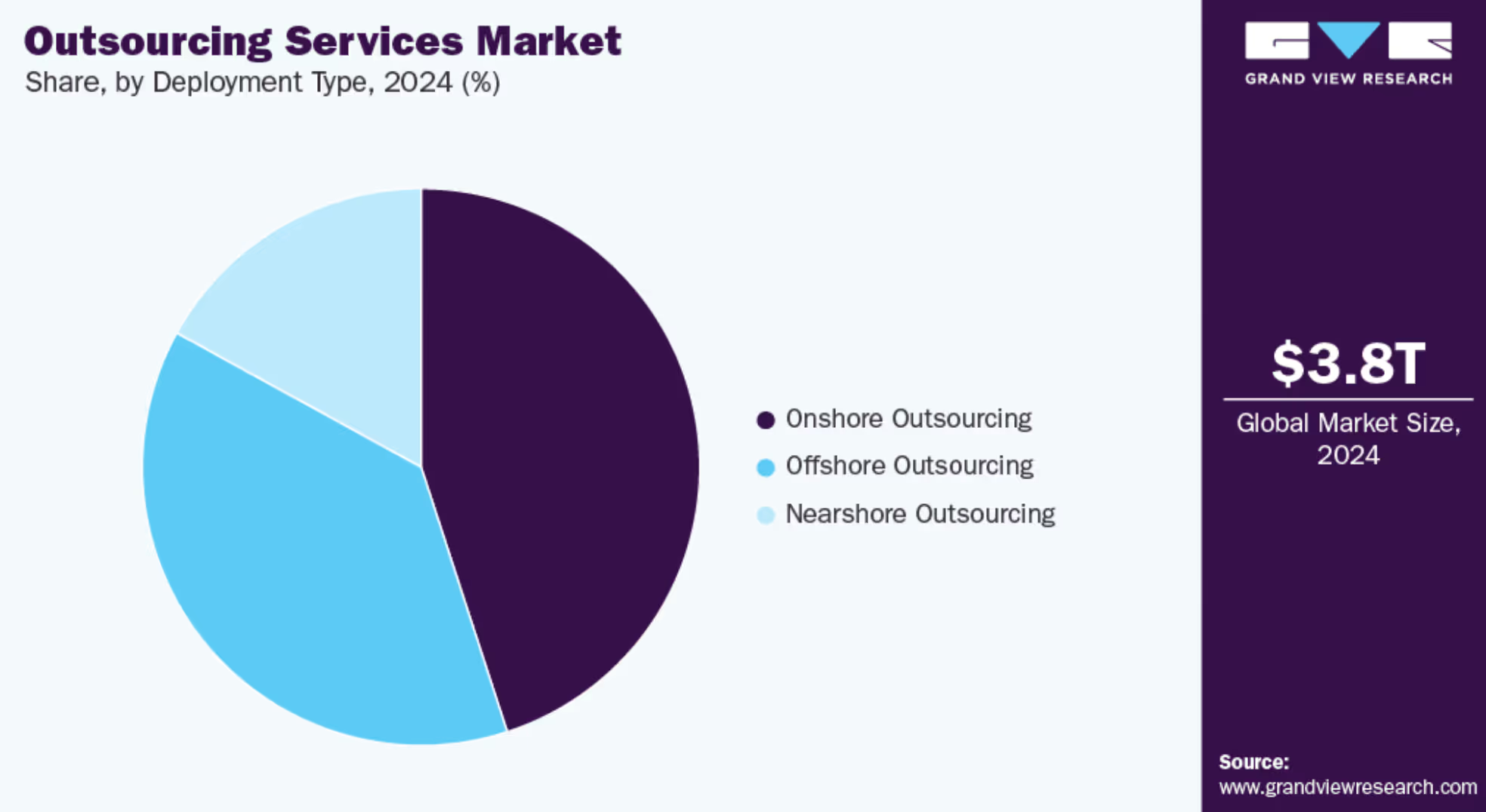
With a $3.8 trillion market share, as of the latest report from Grand View Research, this breaks down to an approximately $1.7 trillion market share for onshore outsourcing, $1.4 trillion for offshore, and $650 billion for nearshore. The distribution highlights a balanced global sourcing mix rather than offshore dominance.
Source: Grand View Research.
Estimated at $358.58 billion in 2026, the global business process outsourcing (BPO) market is expected to grow to $695.77 billion by 2033. This represents a CAGR of 9.9% from 2026 to 2033, according to BPO statistics.
Sustained growth at this pace signals that outsourcing is not a short-term trend but a long-term structural shift in how organizations operate.
Source: Grand View Research.

Valued at $8.7 billion three years ago, this segment is expanding rapidly at a 28.44% CAGR within the broader outsourcing landscape.
Virtual assistant statistics indicate this growth reflects increasing reliance on externally delivered administrative, customer support, marketing, and operational services performed by remote professionals rather than in-house staff.
Source: Verified Market Research.
The finance and accounting segment leads the outsourcing market, accounting for more than 21.4% of total revenue share in 2025.
The dominance of this segment highlights how outsourcing remains deeply embedded in core financial operations across global enterprises.
Source: Grand View Research.
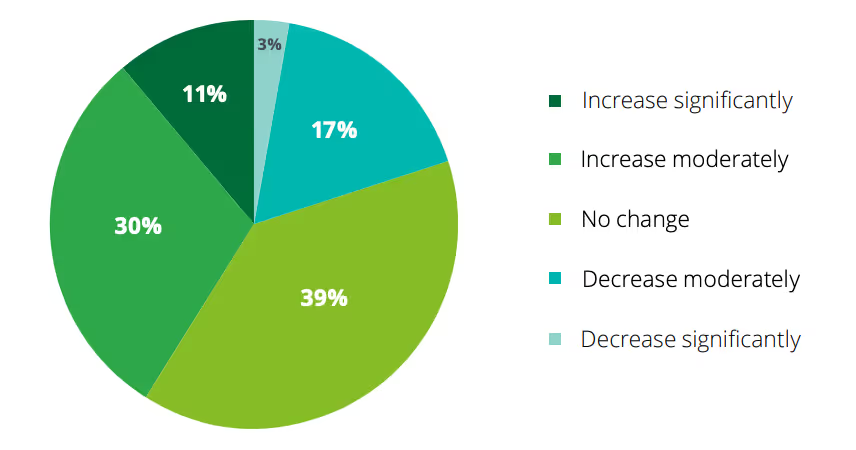
Despite growth in insourcing, third-party outsourcing spending is still expanding. According to the latest Deloitte Global Outsourcing Survey, 11% of respondents expect outsourcing to increase significantly, while an additional 30% foresee moderate increases.
Meanwhile, 39% of respondents expect no change and 20% predict a decrease in investment in outsourcing, with 3% expecting a significant decrease.
Outsourcing remains a central component of workforce strategy, particularly as companies seek specialized skills and scalable delivery models.
Source: Deloitte.
Outsourcing budgets remain resilient despite broader sourcing shifts toward insourcing and GICs (Global In-house Centers).
At the same time, delivery expectations are evolving. Organizations report growing adoption of outcome-based models, with value creation, access to skilled talent, and operational agility joining cost reduction as primary drivers.
The data signals that outsourcing is maturing from a cost-efficiency tactic into a longer-term strategic lever.
Source: Deloitte.
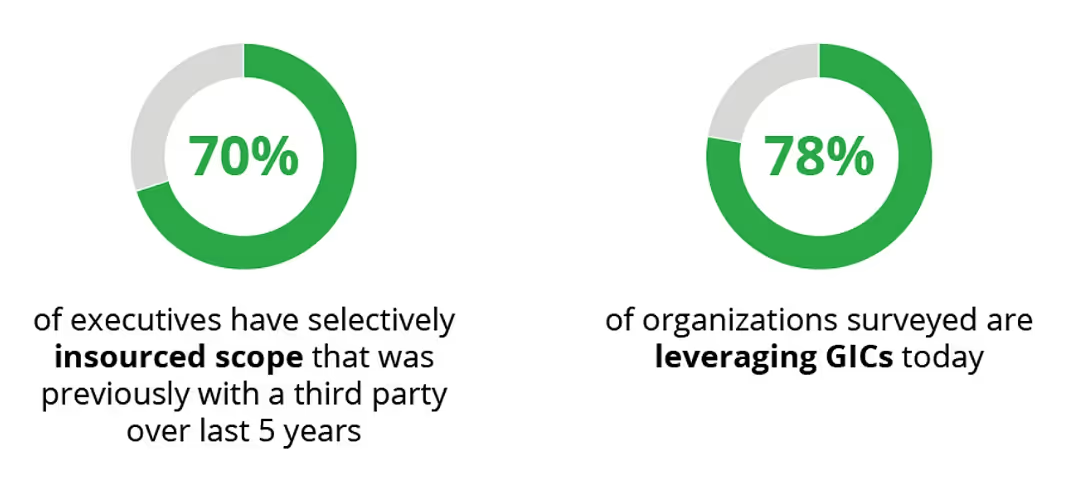
Organizations are expanding how they structure global talent models. Many companies report selectively insourcing certain functions while also building GICs to strengthen internal capabilities.
Rather than replacing outsourcing, this reflects a portfolio approach to sourcing. Enterprises are combining third-party providers, internal teams, and GICs to balance control, scalability, and access to global expertise within a unified operating model.
Source: Deloitte.
A 2021 survey highlights how deeply external providers are embedded in enterprise workforce planning post-pandemic. Rather than operating as isolated vendors, third-party teams are increasingly managed alongside employees within a unified talent model.
The shift reflects a broader structural change: outsourcing is no longer just procurement-driven, but it is integrated into long-term workforce design.
Source: The Wall Street Journal.
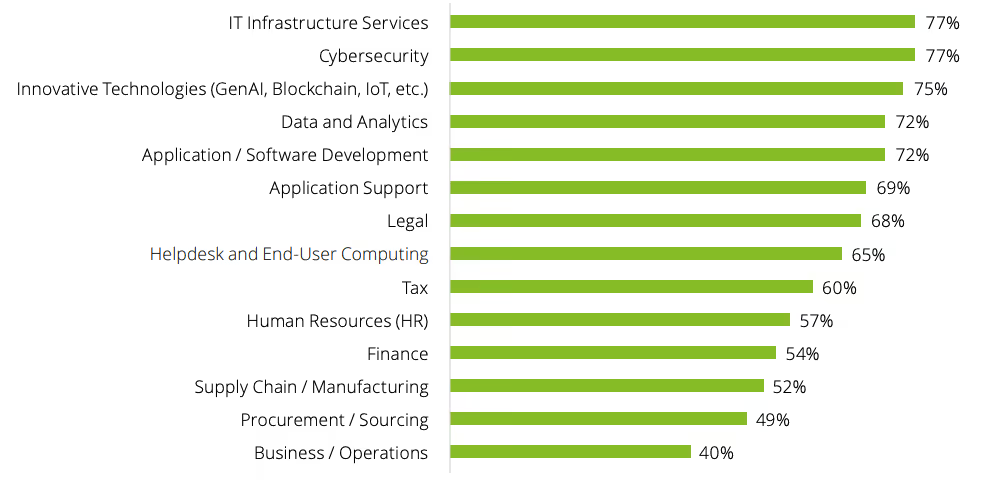
Technology functions remain the most commonly outsourced scope areas, with nearly 8 in 10 organizations outsourcing IT infrastructure services, and an equal ratio outsourcing cybersecurity capabilities.
Other high-demand areas include innovative technologies such as GenAI, blockchain, and IoT (75%), as well as data and analytics (72%) and application/software development (72%).
By contrast, business and operations functions are outsourced less frequently, with 40% reporting outsourcing in that category. The data shows that outsourcing remains most concentrated in technology and digital capabilities.
Source: Deloitte.
Technology outsourcing is nearly universal among the world’s largest enterprises. External vendors now play a central role in infrastructure, data engineering, and AI capabilities, signaling that digital operations are deeply intertwined with third-party expertise.
Source: DemandSage.
More than half of surveyed companies rely on third-party providers for sales, marketing, customer service, and order fulfillment activities. Adoption has increased about 10% since 2022, reflecting broader acceptance of outsourcing in revenue-generating functions and efforts to accelerate growth through external partnerships.
Source: Deloitte.
Nearly half of organizations report outsourcing elements of product development and innovation. This represents a roughly 10% increase compared to 2022, signaling expanding comfort with external providers in strategic, knowledge-intensive work across industries.
Source: Deloitte.
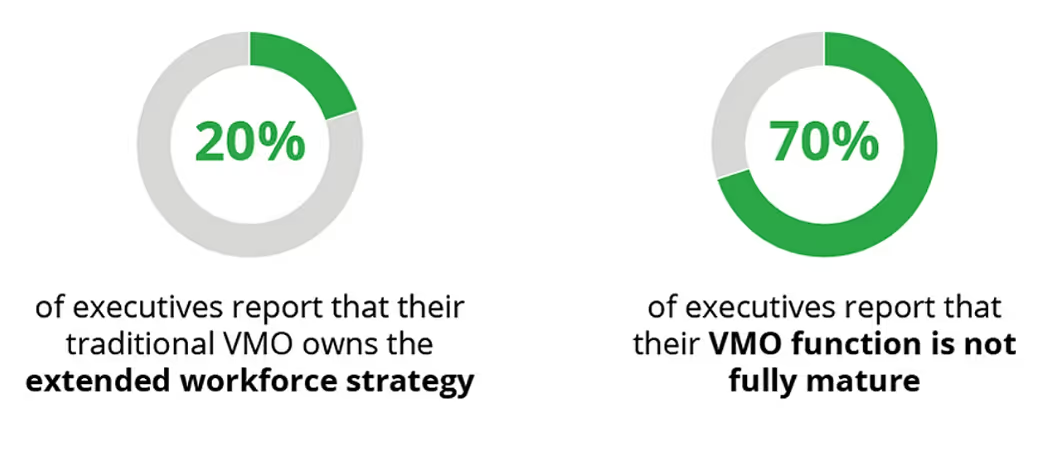
As organizations navigate a multidimensional talent model that spans outsourcing providers, insourced teams, contractors, and AI-driven tools, governance structures are still catching up.
Only about 1 in 5 companies report that their traditional Vendor Management Office (VMO) formally owns the extended workforce strategy. At the same time, about 7 in 10 acknowledge gaps in the maturity of their VMO capabilities.
This highlights a governance challenge: as sourcing complexity increases, integrated oversight across all talent channels remains underdeveloped.
Source: Deloitte.
Outcomes vary across outsourcing engagements, particularly when governance structures are still developing. Industry data suggests up to a quarter of relationships conclude within the first two years, often due to misaligned expectations, unclear performance metrics, or evolving business priorities.
The statistic underscores the importance of structured vendor management, defined KPIs, and strong communication frameworks in building durable, high-performing partnerships.
Source: DemandSage.
Outsourcing involves risk, but most U.S. businesses report positive outcomes from their outsourcing engagements.
The contrast suggests that while some partnerships fail early, well-managed relationships deliver sustained value. Clear expectations and structured oversight play a central role in long-term success.
Source: Entrepreneur.

Access to skilled talent is the top driver behind outsourcing adoption, cited by more than 4 in 10 respondents.
Other significant motivators include increasing customer demands (35%), spend optimization (34%), improved quality/performance (33%), and adoption of a global delivery model (33%).
That over one-third of respondents cite rising customer expectations underscores intensifying competition and the normalization of digital experiences. Businesses increasingly depend on outsourcing to scale, improve service, and stay responsive.
While immediate cost savings have long been an incentive for outsourcing adoption, particularly among first-time adopters, this shift marks evolution from cost-driven outsourcing toward talent-driven outsourcing.
Source: Deloitte.
Outsourcing is no longer limited to large enterprises. A majority of American businesses report delegating at least one function to an external provider, indicating mainstream adoption across company sizes and industries.
Source: DemandSage.
Outsourcing is not confined to enterprise strategy. Smaller firms increasingly use external providers to offset limited internal resources and compete with larger organizations.
Source: DemandSage.
About 56% of the non-self-employed U.S. workforce holds roles that can be performed remotely, particularly knowledge-based and digital functions.
These roles form the backbone of modern outsourcing categories, including IT services, customer support, finance, marketing, and administrative operations.
Source: U.S. Career Institute.
The data highlights a correlation between flexible operating models and third-party talent adoption, suggesting that companies comfortable with distributed workflows may be more inclined to integrate external providers into their staffing strategy.
Source: U.S. Career Institute.
Some industries have reduced office-related expenses by more than 20%, highlighting how outsourcing can materially reshape cost structures.
Source: U.S. Bureau of Labor Statistics.
Reported savings stem primarily from lower overhead, benefits, infrastructure, and idle-time expenses compared to fully in-house roles. In many cases, organizations also avoid the recruiting, onboarding, and training costs required to build in-house capacity, particularly for narrowly defined or project-based roles.
The data illustrates how task-level outsourcing can shift certain support functions from fixed overhead to more flexible operating costs.
Source: AOVUP.

This figure reflects a sizable labor pool dedicated to delivering outsourced administrative, customer support, marketing, and specialized business services. With growth projected for the mid-millions by the late 2020s, its scale underscores the maturity of this segment within the global outsourcing market.
Source: ai2people.
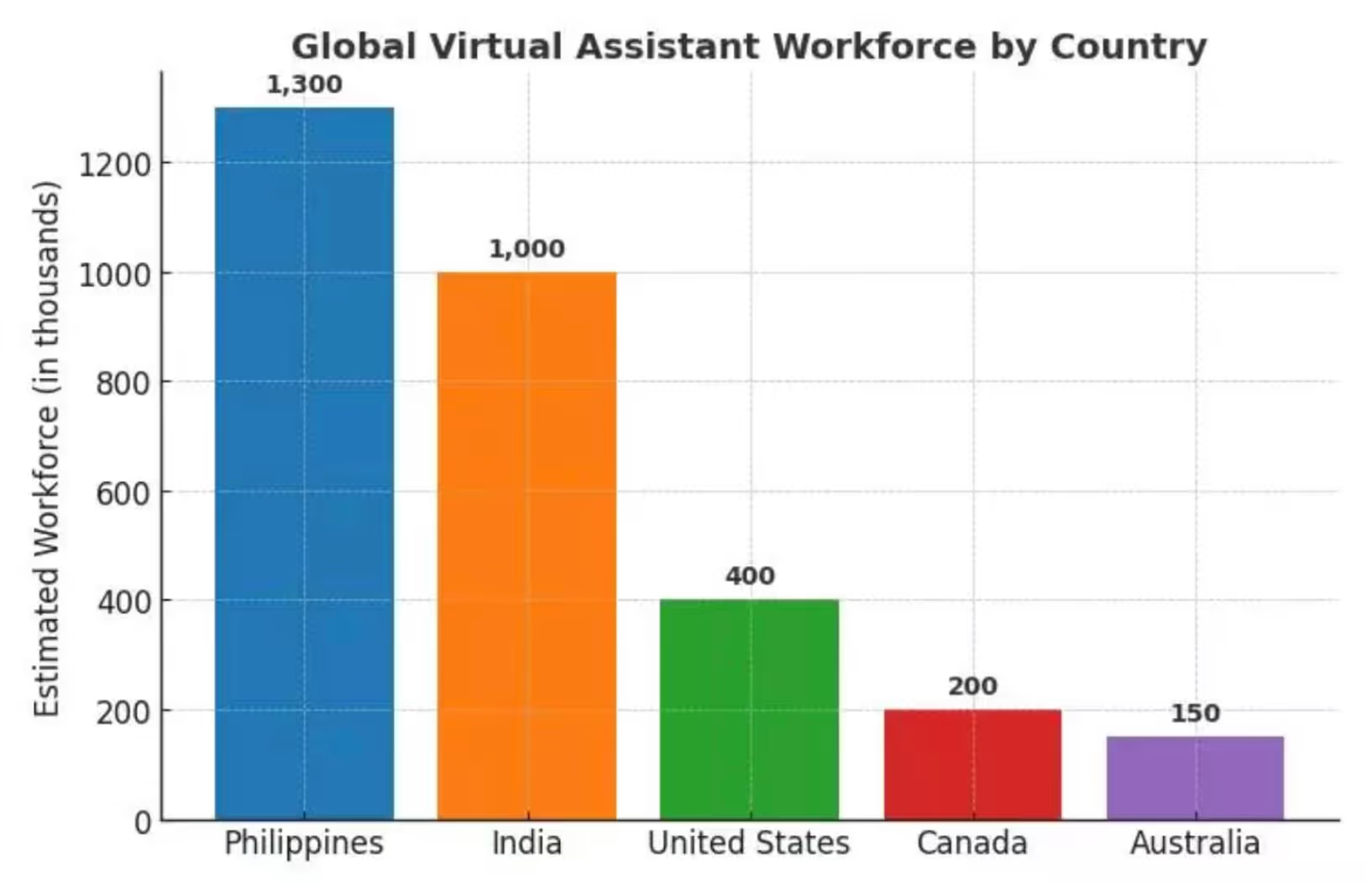
The country represents one of the largest concentrated talent hubs in this outsourcing category. In fact, it’s the second largest industry in the country. The Philippines leads India (1 million), the United States (400,000), Canada (200,000), and Australia (150,000). Its workforce scale reinforces its longstanding role in offshore service delivery and business process support.
Source: ai2people.
Adoption at the enterprise level indicates that task-based outsourcing is not confined to small businesses. Larger organizations are incorporating external assistants into formal workforce structures, signaling mainstream integration rather than experimental use.
Source: ai2people.
Software development remains one of the most commonly offshored functions. The data reflects continued reliance on global engineering talent to manage development costs and address skill shortages.
Source: DemandSage.
Remote CoWorker helps organizations implement outsourcing strategically. We connect you with vetted remote professionals across customer support, marketing, tech support, web development, bookkeeping, back office support, and more, aligned to your workflows and performance goals.
Whether you’re in healthcare, ecommerce, finance, or hospitality, or another industry and want to augment an internal team or build a blended workforce model, our approach prioritizes integration, accountability, and measurable outcomes.
If you’re ready to scale smarter, reduce fixed costs, and strengthen your talent strategy, schedule a free strategy call and explore how Remote CoWorker can help you find remote talent and support your growth.
We believe happy teams build great companies. That’s why we ensure the virtual assistants we provide are supported, skilled, and ready to help your business succeed.


Copyright © 2026 RemoteCoWorker | All Rights Reserved.